

Even though Hawaii is a visitor magnet and more people come to the Islands each year, Hawaii also has its downside. Here is a list of some island troubles - challenges the Islands and their people struggle with.
Cost of Living in Hawaii
Hawaii residents often complain about the Islands' high cost of living. Compared with many places on the continental United States, groceries, housing, utilities, fuel and everyday goods often cost more in Hawaii. Shipping plays a role because many items arrive by ship or airplane, but it is not the only reason prices are high.
Businesses in Hawaii also face higher land costs, storage costs, labor costs, energy costs and operating expenses. Retailers often need to carry larger inventories because Hawaii is far from major supply centers. Hawaii's general excise tax also adds to the cost of many goods and services.
However, the main reason living in Hawaii is expensive is housing. On Oahu, the 2025 median sale price was $1,139,000 for a single-family home and $507,250 for a condo. Rent is also high, especially in Honolulu, Waikiki and other areas close to jobs, schools, beaches and services.
There are several reasons why housing is so expensive in Hawaii. One factor is the limited amount of land onto which the cities could expand. Another reason is the higher construction costs that are due to high shipping and inventory costs of the material and excise taxes, among others. Furthermore, housing is usually more expensive in attractive places to live, where the quality of life is good. Hawaii has several desirable qualities, such as clean air and water, a pleasant climate, forests, mountains, the ocean, a culturally diverse population and many restaurants and nightlife options.
Population Size
Hawaii's population has grown over the long term, although recent estimates show a decline after the 2020 Census. Hawaii's resident population was estimated at about 1.43 million in 2025.
Oahu remains the population center of the state. Many residents live and work in Honolulu County, which makes daily life feel crowded in certain areas, especially during weekday commute hours. Oahu's nickname, "The Gathering Place," fits both its cultural role and its population concentration.
Traffic Congestion
Hawaii residents and visitors frequently complain about traffic. It is one of the most common frustrations in the Islands. Traffic is usually worst during the morning and afternoon rush hours. On Oahu, the H-1 and H-2 freeways can be heavily congested. On Maui, parts of Honoapiilani Highway can back up, while on Kauai, Kuhio Highway around Lihue can slow down during busy times.
There are two main reasons Hawaii's roads become packed. First, many people rely on cars for commuting. Second, the road system is limited by mountains, ocean, old town layouts and the small amount of land available for major road expansion.
The state has tried different ways to reduce traffic congestion, including contraflow lanes, HOV lanes, coordinated traffic signals, road widening and public transportation improvements. These efforts help in some areas, but they have not solved the problem permanently.
There is ongoing debate about what should be done. Some people argue for stronger public transportation and rail systems, especially on Oahu. Others support road pricing, parking changes, fuel taxes, remote work options or better planning around where people live and work.
Junk Cars
Abandoned junk cars are a statewide problem in Hawaii. On Oahu, Maui, Kauai and the Big Island, old cars can sometimes be seen on roadsides, in yards, over cliffs or left in rural areas. Many sit for years, rusting and falling apart.
Before an old car fully deteriorates, people may remove parts that still have value. Once a vehicle is stripped, it becomes harder to donate, tow or dispose of properly.
Junk cars are not only unpleasant to look at. They can also create environmental and safety hazards. Leaking petroleum, batteries, tires and other fluids can harm soil and water. Junk vehicles may also collect standing water, which can provide breeding areas for insects and other pests, such as rats, parasites, lice and bugs and other little critters.
There are legal ways to dispose of unwanted vehicles, and some organizations tow cars that still have parts intact. The problem is that abandoned vehicles often appear after they have already been stripped or dumped in inconvenient places.
Homelessness
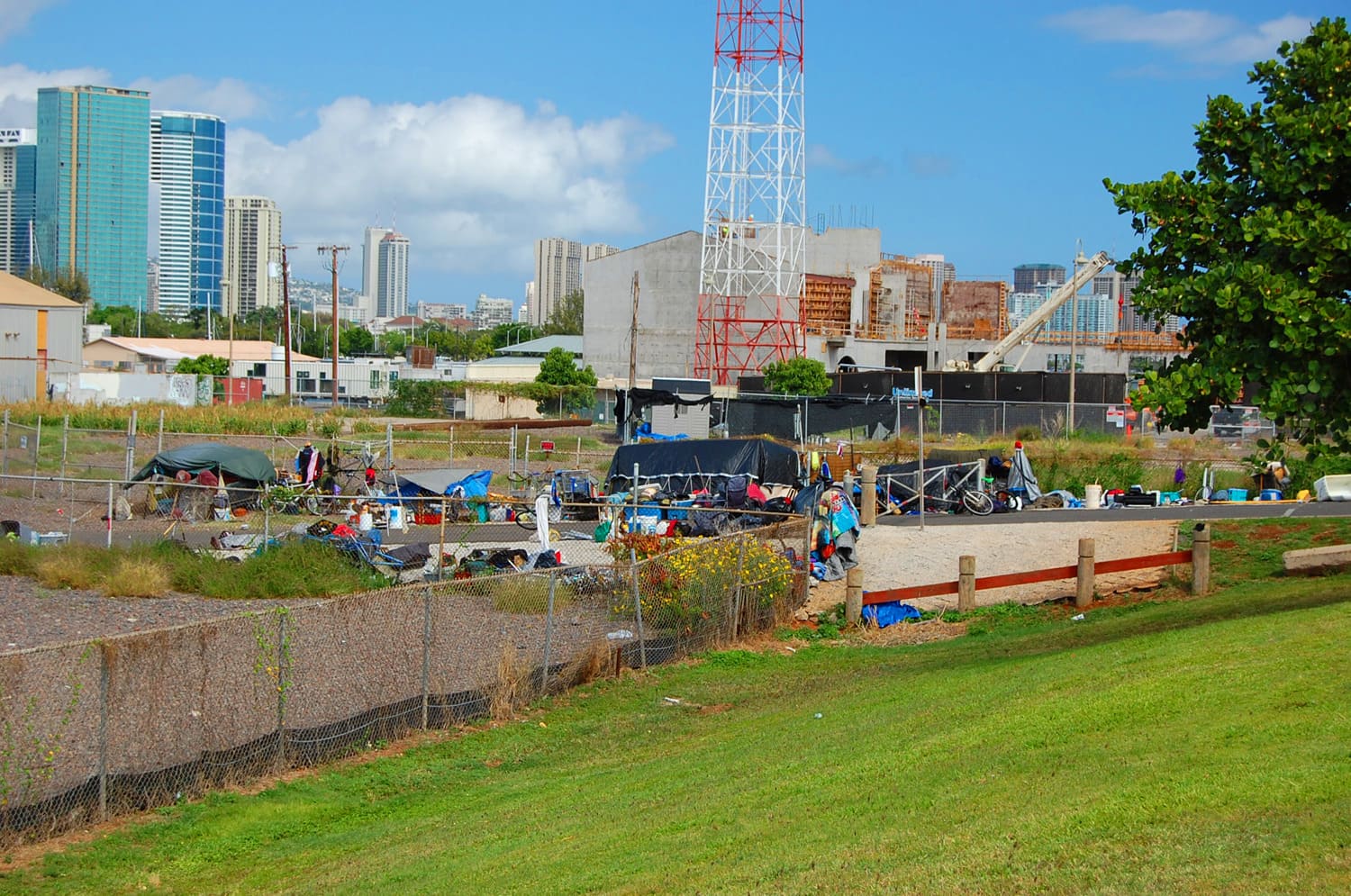
Besides Hawaii being a favorite residency and vacation spot for many people, the Islands also have a large homeless population. Homeless people in Hawaii have set up camp in many places - in beach parks, under highway overpasses, under portable school buildings, under trees and in other places. Others live in their cars, often entire families, or in tents on more isolated beaches. Some homeless have all their belongings in large backpacks or push them around in shopping carts.
The 2024 statewide Point-in-Time count found 6,389 people experiencing homelessness in Hawaii. Oahu had the largest number, followed by Hawaii Island, Maui County and Kauai County.
Homelessness in Hawaii is tied to many factors, including high housing costs, low wages compared with rent, lack of affordable housing, drug abuse, mental health needs, family instability, health issues and the cost of living. Hawaii's warm climate also makes homelessness more visible because people can survive outdoors year-round.
The state, counties and nonprofit organizations continue to work on shelters, outreach, housing programs, health services and supportive housing. Progress is difficult because the housing shortage affects people at many income levels.
Drug Epidemic
Drug abuse is a major cause of crime in Hawaii. Methamphetamine, commonly known as crystal meth or "ice," has affected Hawaii communities for decades and is connected to crime, homelessness, family stress, health problems and lost work or school stability.
Crystal meth is known to be a highly addictive stimulant. It can create strong feelings of euphoria, but also anxiety, paranoia, depression, hallucinations, unpredictable behavior and long-term health problems. As the drug wears off, one may experience physical weakness and a strong "come-down" effect.
Crystal meth use in Hawaii is not a recent problem. It started in the late 1970s, but since then, the number of people smoking "ice" has steadily increased. Treatment, prevention, enforcement and family support remain important parts of addressing the problem.
Noise
Some areas in Hawaii can be quite noisy, mainly parts of Oahu, where the majority of the people live. Honolulu and Waikiki are large metropolitan areas with plenty of people and cars. Large cities tend to be noisy and so are Hawaii's bigger urban areas. In the last decades, construction has contributed to a lot of noise. New shopping centers, apartment complexes and hotels have been built around town, and construction sites are loud.
Another noise factor is car alarms. Residents in Waikiki and other parts of Oahu and the other Hawaiian Islands often complain that car alarms go off for no reason. Sometimes a big truck or motorcycle with a loud engine is enough to set off parked car alarms because of motor vibrations. Car alarms are heard so frequently in some areas that many people no longer pay attention when they hear another one.
Garbage trucks can also be a pain for one's ears. Often, they can already be heard early in the morning, even in residential neighborhoods, picking up trash. What is worse is that it is not only their loud motor. In order to pick up large dumpsters, they need to drive backwards, which causes the vehicle to beep as a safety precaution. This beeping can feel like an unwanted alarm clock, especially if it happens earlier than you planned to wake up.
High Electricity Costs
Hawaii has some of the highest electricity costs in the United States. In 2024, the average retail electricity price in Hawaii was much higher than the national average.
Historically, Hawaii relied heavily on imported petroleum for electricity generation. That made electricity prices sensitive to oil prices and shipping costs. The state has been adding more solar, wind, battery storage and other renewable energy sources, but power costs remain a major issue for households and businesses.
High electricity costs affect daily life in many ways. Residents may limit air-conditioning use, choose energy-efficient appliances, install solar panels when possible, or look for other ways to reduce monthly bills.
Crime and Safety Concerns
Murder is less of an issue in Hawaii than in many mainland areas. It does happen, as do rape and violent assault, but the most common types of crime in Hawaii include car and apartment or house break-ins, stolen cars and purse snatchings.
Visitors should avoid leaving valuables in cars, especially at beaches, scenic lookouts and trailheads. Wallets, bags, phones, cameras and luggage should not be left visible in parked vehicles.
Waste and Landfills
Another statewide problem is where to dump garbage. Hawaii has limited land, and landfill space is difficult to expand. On Oahu, there has long been debate about whether to create new landfill space, rely more on waste-to-energy, reduce waste, improve recycling or ship certain waste elsewhere.
The challenge is finding disposal sites that do not threaten communities, cultural sites, water resources or coastal ecosystems. Waste management is especially difficult in an island state where land is limited and shipping costs are high.
Other Hawaii Troubles
Other island challenges include bugs and little critters in Hawaii, marine debris in the Hawaiian Islands and stress on the Hawaiian coral reef.
Environmental Pressure
Hawaii's environment faces pressure from development, climate change, sea level rise, invasive species, pollution, wildfire risk, heavy visitor use and damage to reefs, trails and coastlines.
Even small daily choices can affect island resources. Proper trash disposal, reef-safe behavior, staying on marked trails, respecting closed areas and supporting local conservation efforts all help reduce pressure on Hawaii's land and ocean.
Living With Hawaii's Challenges
Hawaii is beautiful, but it is also a real place with complex problems. High costs, limited land, crowded roads, homelessness, waste, energy prices and environmental concerns affect the people who live here every day.
Visitors can help by respecting local communities, supporting local businesses, reducing waste, avoiding illegal parking, protecting reefs and traveling with patience and aloha.


