
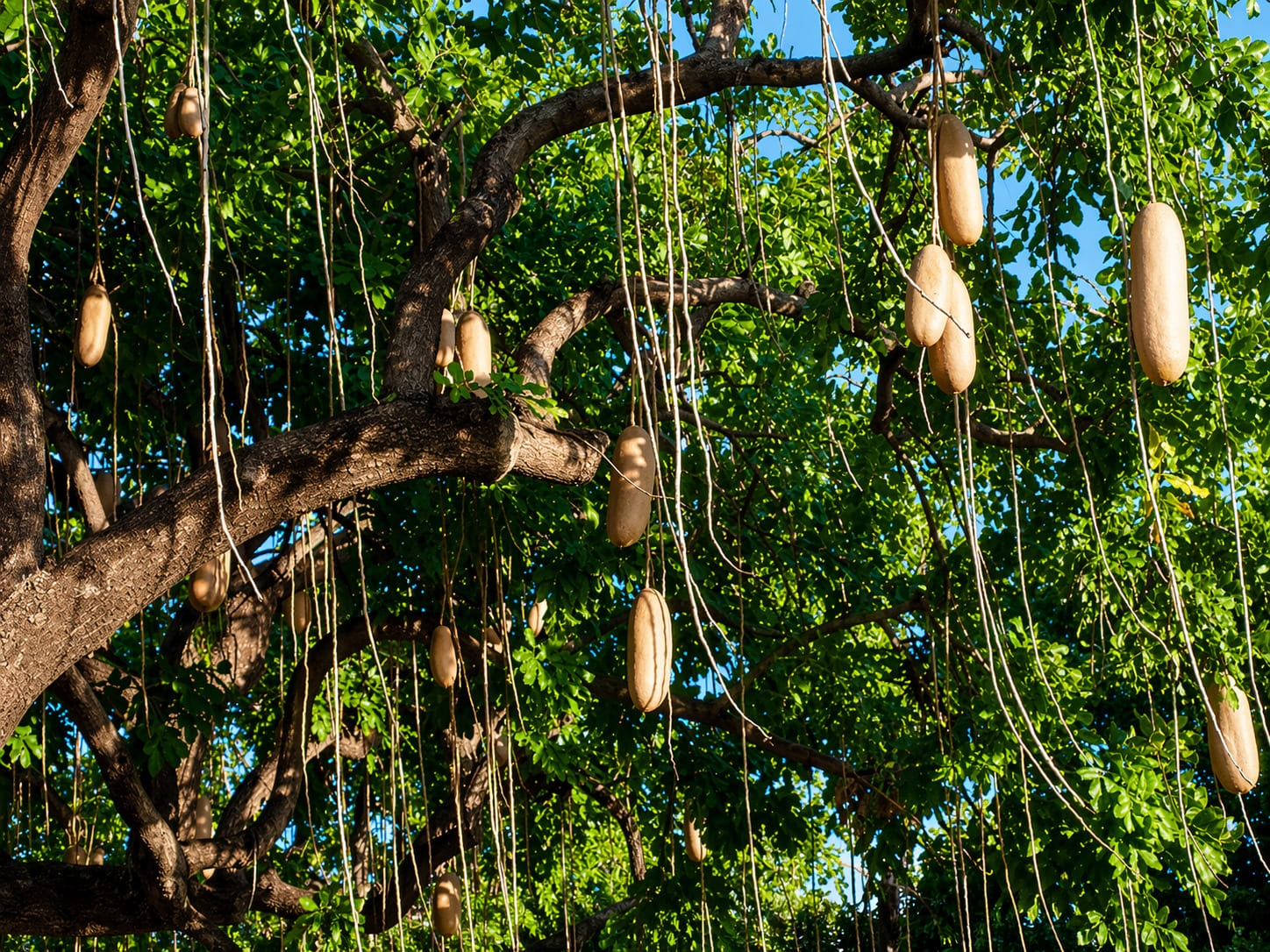

Sausage Tree Overview
The sausage tree, or Kigelia africana, gets attention quickly because of its unusual fruit. Long, heavy, sausage-shaped pods hang from the branches, giving the tree a look that is hard to forget. Native to Africa, the tree can grow up to about 65 feet tall and may appear in tropical gardens, parks and warm landscape settings.
Its fruit is heavy, wood-like and difficult to open without a knife. While the shape can look funny at first, the fruit is not something to treat casually. In its raw state, it is poisonous. In parts of Africa, traditional uses involve drying, roasting or fermenting the fruit first, but raw fruit should not be eaten.
Fruit, Bark and Tree Form
Older sausage trees often have grey, peeling bark, while the wood is pale brown to yellow. The tree's broad canopy can provide shade, but the dangling fruit makes placement important. A falling fruit can cause serious injury, so this is not the kind of shade tree where people should sit or picnic underneath.
Compared with flowering ornamentals such as the royal poinciana tree, jacaranda tree or golden shower tree, sausage tree is less about color and more about form. Its fruit is the main feature, and that feature brings both curiosity and caution.
Sausage Trees in Hawaii Landscapes
In Hawaii, the sausage tree is an introduced ornamental rather than a native forest tree like koa or a canoe plant like coconut. It fits best in spacious landscapes where its size, fruit drop and canopy can be managed safely.
The sausage tree may not be common everywhere, but once seen, it is easy to remember. Its strange hanging fruit, peeling bark and tropical shape make it one of the more curious trees in Hawaii's collection of introduced ornamentals.


