

Voice of the Islands
Hawaiian Language
Hawaiian language carries the sound, stories and identity of the Islands, from its short alphabet and pronunciation marks to its modern cultural revival.
Related topics
Explore Hawaiian Language
Browse more topics in this Hawaiian Language guide.
Olelo Hawaii
The Hawaiian language (Olelo Hawaii) is one of the oldest living languages in the world. The Hawaiian language has had a tumultuous history and was at one point even expected to be extinct by the end of the 20th century. However, a Hawaiian language “renaissance” has occurred over the past 40 years, and today more people are interested in learning the language again. Hawaiian is being taught in language immersion schools, and one can even obtain a Master's degree in the Hawaiian language from the University of Hawaii. Nevertheless, only about 0.1% of the people who live in Hawaii speak its native tongue today.
History of the Hawaiian Language
Before Captain Cook's arrival in Hawaii in 1778, Hawaiian was strictly an oral language. Cook and his men recorded the Hawaiian language for the first time in 1778. They noticed that the language was similar to Tahitian and Maori.
When the first missionaries arrived in Hawaii in 1820, they converted the oral Hawaiian language to a written language so that they were able to convey the messages of the Bible to the Hawaiian people.
By 1826, the missionaries had created a Hawaiian alphabet. They also taught Hawaiians to read and write the language and translated the Bible into Hawaiian.
The Hawaiian Language Banned
After the annexation of Hawaii as a territory of the United States in 1898, the language was officially banned from schools and the government. Use of the Hawaiian language was even banned at Kamehameha Schools – a private school system reserved only for children of Hawaiian descent.
It is important to note that this ban of the Hawaiian language was not made against the language in general. People were still allowed to speak Hawaiian on a daily basis. In fact, there were fourteen separate newspapers that were printed in Hawaiian. Notables are the Ka Lama Hawaii and Ke Kumu Hawaii, which began as early as 1834 and the Ka Nupepa Kuoka, which had a 66-year-run from 1861 to 1927.
Resurrection of the Hawaiian Language
In 1978, the Hawaiian language was recognized as one of the official languages of the state of Hawaii (the other being English). Public Hawaiian language immersion preschools were established in 1984, and other immersion schools soon followed.
Today, there are about 1,000 native Hawaiian speakers and around 8,000 people who can speak and understand the language fluently according to the UCLA Language Materials Project. It is a far cry from the estimated 400,000-800,000 native Hawaiian speakers during the time of Captain Cook, but it's a good start at resurrecting a dying language.
Hawaiian at a Glance
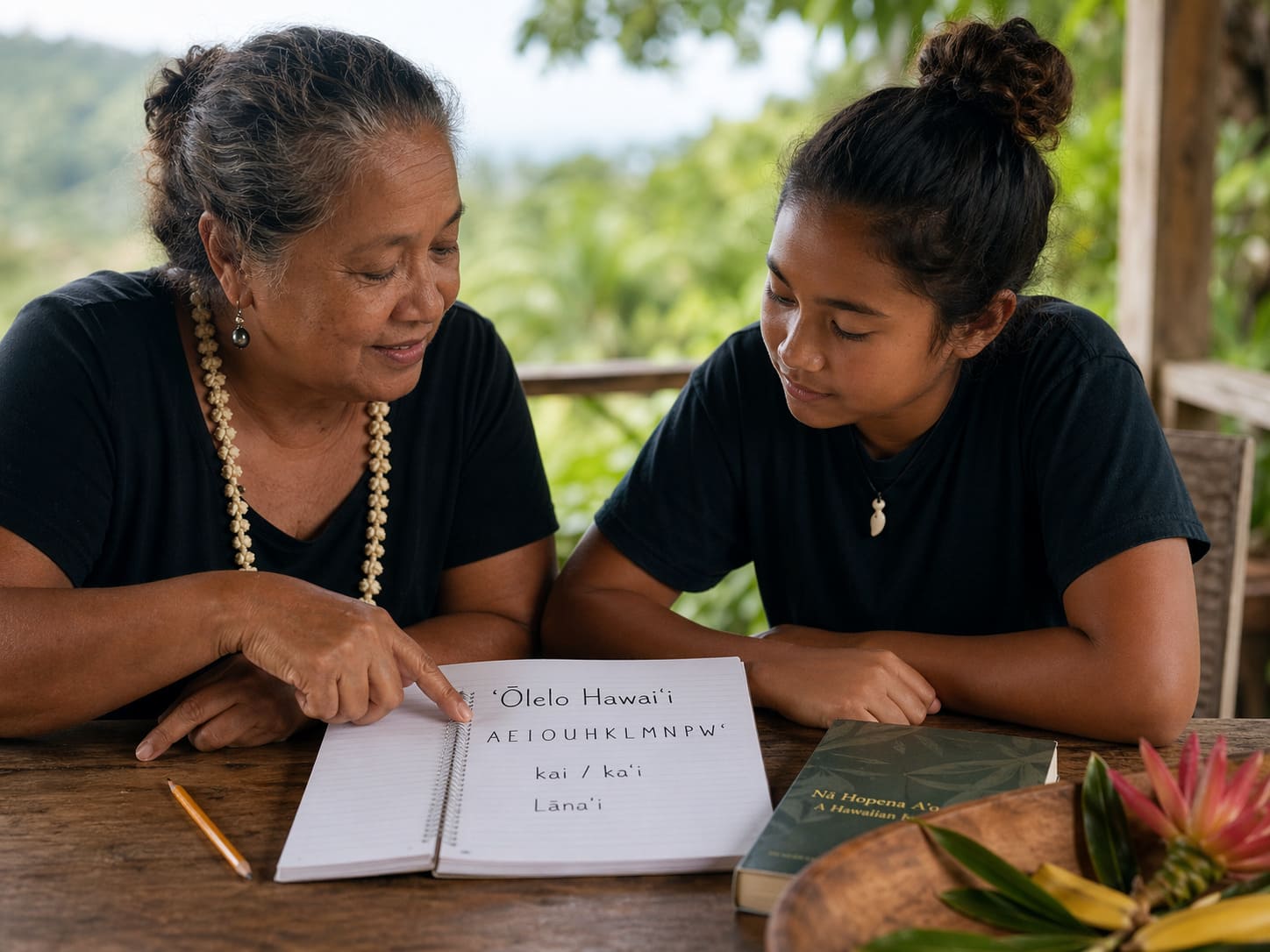
The Hawaiian alphabet is as follows:
A, E, I, O, U, H, K, L, M, N, P, W, ‘
There are four basic rules in the Hawaiian language:
- All words end in a vowel.
- Every consonant is followed by at least one vowel.
- Every syllable ends in a vowel.
- Two consonants never appear next to each other.
The Hawaiian alphabet consists of 13 letters – five vowels and eight consonants, one of them being a glottal stop (called okina). The reason why the okina is considered a consonant is because an okina that is missing can change the meaning of a word, as the following example illustrates:
kai = sea
kai = to lead
An okina indicates a break in the sound when a word is spoken. It is written with a backward apostrophe (‘). When saying a word that has an okina the symbol indicates a slight pause, similar to when one says “uh-oh” to show concern.
Another example is lanai vs. lanai. The word “lanai” without the okina is pronounced “lah-nigh” and means balcony. The word “lanai” is pronounced “lah-nah-ee.” Lanai is one of the Hawaiian islands.
Another pronunciation example is “Molokai” (Molokai is one of the Hawaiian islands). If we write the island name without the okina, it is pronounced “Moh-loh-kai” (kai like sky). If we write it with the okina, it reads Moloka‘i and is pronounced “Moh-loh-kah-ee.” Both pronunciations are acceptable and equally common (because most people today are not native Hawaiian speakers), but you should be cautious because sometimes an okina can change the meaning of a word.
The okina is only found between two vowels or at the beginning of a word. Native and traditional speakers use the okina whenever they speak or write Hawaiian. The okina is not always used in print and on the Internet. It is, however, used in major Hawaiian newspapers and many books on Hawaiiana.
Another grammatical mark in the Hawaiian language is the kahako, a symbol that looks like a line (-) that is placed over a vowel. When you see this, it means that it is a long vowel – simply drag the vowel out a bit longer than you normally would. It is a subtle difference that can be difficult to get the hang of. And even though it's not considered a letter, the absence or presence of it can also change the meaning of a word.
Hawaiian vowels are pronounced differently than they are pronounced in the English language.
- A is pronounced “ah”
- E is pronounced “eh”
- I is pronounced “ee”
- O is pronounced “oh”
- U is pronounced “oo”
Traditionally, the W in the Hawaiian language sounds like the letter “V” in the English language.
When consonants are paired with vowels, they join the vowel sound. For example, the letter “H” paired up with the vowels would sound like this:
- Ha would sound like “Hah”
- He would sound like “Heh”
- Hi would sound like “Hee”
- Ho would sound like “Hoh”
- Hu would sound like “Hoo”


Frequently Asked Questions
What is the Hawaiian word for the Hawaiian language?
The Hawaiian language is often called Olelo Hawaii. Olelo means language or speech, and Hawaii refers to the Hawaiian people, land and islands.
Is Hawaiian an official language of Hawaii?
Yes. Hawaiian and English are both official languages of the State of Hawaii.
How many letters are in the Hawaiian alphabet?
The Hawaiian alphabet has 13 letters: five vowels, seven regular consonants and the okina, which represents a glottal stop.
What is an okina?
The okina is a glottal stop, or brief pause in sound. It can change both the pronunciation and meaning of Hawaiian words.
What is a kahako?
A kahako is a line placed over a vowel. It tells the reader to hold the vowel sound longer and can also change the meaning of a word.
Was the Hawaiian language ever banned?
An 1896 law required English as the medium of instruction in schools, which greatly reduced Hawaiian language use in education. Hawaiian was still spoken in homes, communities, churches and newspapers.
Is the Hawaiian language still spoken today?
Yes. Hawaiian is spoken, taught and used today through families, immersion schools, universities, cultural programs, music, ceremonies, signage and media.
Can visitors learn basic Hawaiian words?
Yes. Visitors can learn common words such as aloha, mahalo, keiki, ohana, mauka and makai. Learning even a few words shows respect for the language and culture.